Is a keyboard smash a strong password? Usually it is weaker than it looks. A smash may seem chaotic, but it comes from your hands, your favorite keys and familiar movements. A secure generator picks each character without those habits. Length, uniqueness and real randomness matter more than how messy a string appears.
Table of Contents

Is a keyboard smash a strong password, or just a messy one?
A string looks random when you cannot spot a rule in it. A string is random when a process with no human preferences chose each character. Those are different things, and only the second one supports a real strength estimate.
Entropy is a measure of unpredictability, counted in bits, where each extra bit doubles the number of possibilities. An entropy figure only applies when every character is picked independently and unpredictably. NIST SP 800-63B, Revision 4 (released July 2025), notes that estimating entropy for human-chosen passwords is difficult. A keyboard smash is human-chosen, even when it feels accidental.
That does not mean every smash is easy to guess. Its risk depends on its length, how it was made, whether it has ever been exposed, and the strategy someone uses to guess it. It simply means you cannot call a smash random because it looks messy. The Password Entropy Calculator shows length, character pool size and an entropy estimate for any string, but that math assumes random selection, so it flatters a smash.
How do keyboard routes give away a human process?
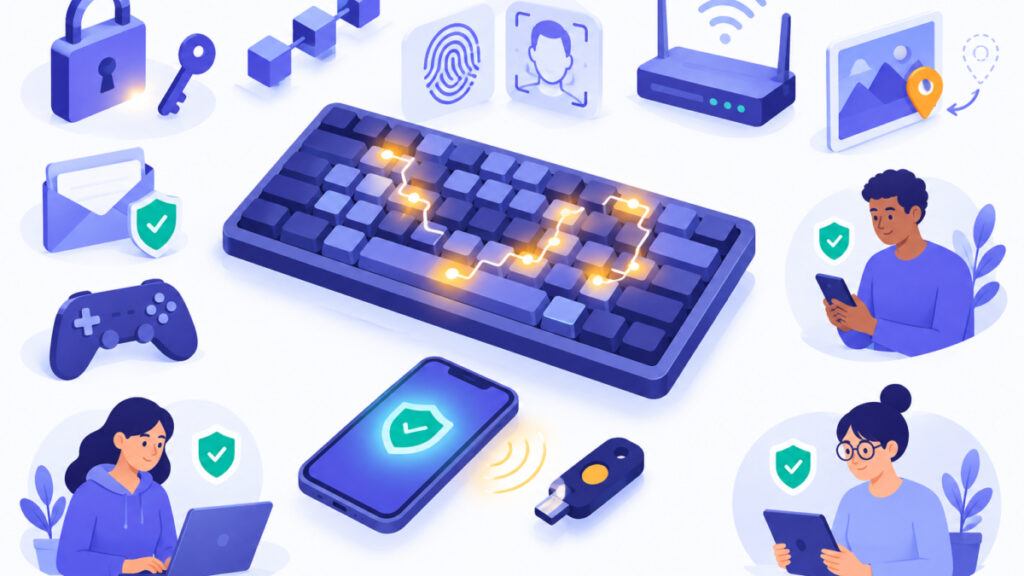
Your hands are not random number generators. When you smash a keyboard, you tend to stay near the home row, favor keys your strongest fingers reach easily, and repeat small motions. Common examples are sweeping across a row or bouncing between neighboring keys. Sample patterns such as qwerty or asdf are shown here only to illustrate the idea. Never use them as passwords.
The mechanism matters more than any single string. Strength estimates assume every possible combination is equally likely. Human habits break that assumption, because some routes and conventions are far more probable than others. That is why password checkers and breached-password screening treat recognizable keyboard sequences as common patterns.
OWASP’s Cryptographic Storage Cheat Sheet warns against treating characters produced by mashing a keyboard as random when generating cryptographic keys. That advice is about encryption keys, not login passwords, so I use it only to illustrate a principle: a person’s sense of randomness is not a source of randomness.
Some smashes will hold up and some will not, and you cannot tell which from looking at them. That uncertainty is the real weakness.

What does a secure generator do differently?
A cryptographically secure random generator removes the person from the choice. Password Ideas states that its Secure Password Generator builds passwords on your device using the browser’s crypto.getRandomValues() method, which MDN describes as providing cryptographically strong random values. You choose the length and character types, and the tool does the choosing. Those are the site’s own descriptions. I have not independently audited the code, so treat them as documented claims, not as proof.
A generated password can contain neighboring letters, such as T and Y side by side, purely by chance. That does not make it weak. What counts is the method that produced it, not whether a human reader spots a pattern afterward. If you want to see how a smaller character pool changes the picture, read my article on whether a random password without symbols is strong enough.
Generated passwords are not meant to be memorized. Save each one in a reputable password manager, and generate your own instead of copying any example you see in an article.
Is a keyboard smash a strong password if I make it longer?
Length helps, but it does not repair a predictable method. A long smash is harder to guess than a short one, yet it may still repeat motions your hand favors. A generated password can rest on firmer ground because its characters are chosen independently.
Symbols do not change that. A symbol enlarges the pool of possible characters, but it is not proof of randomness, and some sites restrict which characters they accept. Swapping letters for lookalike symbols in a smash leaves the habit underneath.
| Source | What it says | Applies to |
|---|---|---|
| NIST SP 800-63B, Revision 4 (July 2025) | At least 15 characters when a password is the only factor, a minimum of 8 when it is used only as part of multifactor authentication, no required character mixtures, screening against common or compromised values, and no routine periodic changes | Services that verify passwords |
| CISA consumer advice | At least 16 characters, random, and unique for each account | Everyday users |
The NIST items are requirements for verifiers, meaning the systems that check your password. They are not a promise that any 15-character password is safe, or that every website follows them. For a deeper look at the numbers, see my piece on three random words and the 15-character minimum.
How can you test a pattern and build a better password?
- Test a made-up pattern, never a live credential. Type an invented keyboard route into the Password Strength Checker. The page says the analysis runs locally in your browser, and it looks at length, common patterns, dictionary words and keyboard sequences. Read the feedback on the pattern it finds.
- Generate your own password. Set a length of 16 or more characters in the generator, then copy the result straight into your password manager.
- Use one password per account. Reuse turns one exposure into many.
- Run a breach check. The Password Leak Checker queries Have I Been Pwned using k-anonymity, a method where only a short fragment of a hashed password is sent, never the password itself. The tool states that only the first 5 characters of the SHA-1 hash leave your device.
- Add a second layer. Turn on two-factor authentication or passkeys where offered. A passkey is a login credential stored on your device, based on FIDO Alliance and W3C WebAuthn standards, that replaces typing a password.
Read scores with care. The checker’s crack-time estimate assumes 10 billion guesses per second, which is the tool’s illustrative assumption, not a measured attack speed or a prediction for your account. A score cannot show how a password was generated, prove it has never been breached, or protect you from phishing. The checker page also gives a general minimum of 12 characters. I would follow the newer 16-character CISA advice instead.
Technical note for beginners: why do developers avoid human randomness?
A cryptographically secure random number generator is a source of randomness designed so that no one can predict its next output from earlier ones. Browsers expose one through crypto.getRandomValues(). Everyday functions such as Math.random() are not built for secrets.
The rule for developers is simple: for anything secret, use the platform’s secure generator, not typed input, timestamps or strings that merely look random. That mirrors the OWASP point about key generation.
If you manage accounts for a small team or school and need many credentials, the Bulk Password Generator can create several passwords at once and export them. Each one should still go to a single person and a single account.
Frequently asked questions
What if my keyboard smash is long?
Length helps, but it does not prove randomness. A long smash can still repeat movements your hand favors. A generated password of the same length has the advantage of independent character choices, so I would generate one instead.
Can a generated password contain a pattern by chance?
Yes. A secure generator may produce neighboring keys or repeated characters occasionally. That does not make the password weak, because strength comes from the method and the length, not from how it looks afterward.
Can a strength score guarantee safety?
No. A score is an estimate based on patterns and assumptions. It cannot show how a password was made, whether it has appeared in a breach, or whether you might type it into a phishing page.
Does adding a symbol fix a keyboard smash?
Not by itself. A symbol enlarges the character pool, but it does not make the underlying choice random. Some sites also limit which symbols they accept.
Should I type my real password into a strength checker?
The Password Ideas checker says it analyzes passwords locally in your browser. Even so, the safer habit is to test invented sample patterns, and never enter a real password into a site you do not trust.
How long should a password be?
CISA recommends at least 16 characters, random and unique for each account. NIST SP 800-63B Revision 4 requires services to set a minimum of 15 characters when a password is the only authentication factor, and allows a minimum of 8 when it is used only as part of multifactor authentication.
Do I need to change my password regularly?
No routine schedule is needed. NIST tells verifiers not to require periodic changes. Change a password when there is a breach or you suspect it has been compromised.
Next steps
So, is a keyboard smash a strong password? Not reliably. It can look chaotic while still reflecting your hands, and you cannot prove how unpredictable it is. A secure generator replaces that guesswork with a documented random method.
Quick recap: generate a password of 16 or more characters, use a different one for every account, store them in a reputable password manager, check for breaches, and add two-factor authentication or passkeys. For a printable action list, grab the Password Safety Checklist.
Related tools and resources on Password Ideas:
- Secure Password Generator
- Password Strength Checker
- Password Entropy Calculator
- Password Leak Checker
- Is A Random Password Without Symbols Strong Enough
- Password Safety Checklist (PDF)
Sources and further reading
- NIST Special Publication 800-63B
- NIST SP 800-63 Digital Identity Guidelines
- Cybersecurity Best Practices | Cybersecurity and Infrastructure Security Agency CISA
- Password Strength Checker
- Secure Password Generator
- Cryptographic Storage – OWASP Cheat Sheet Series
- Crypto: getRandomValues() method – Web APIs | MDN